
Why West Pune Is One of Pune's Fastest Growing Residential Markets
What is actually driving residential demand across Hinjewadi, Wakad, Baner, Balewadi, and Punawale — and what buyers should factor into a decision.
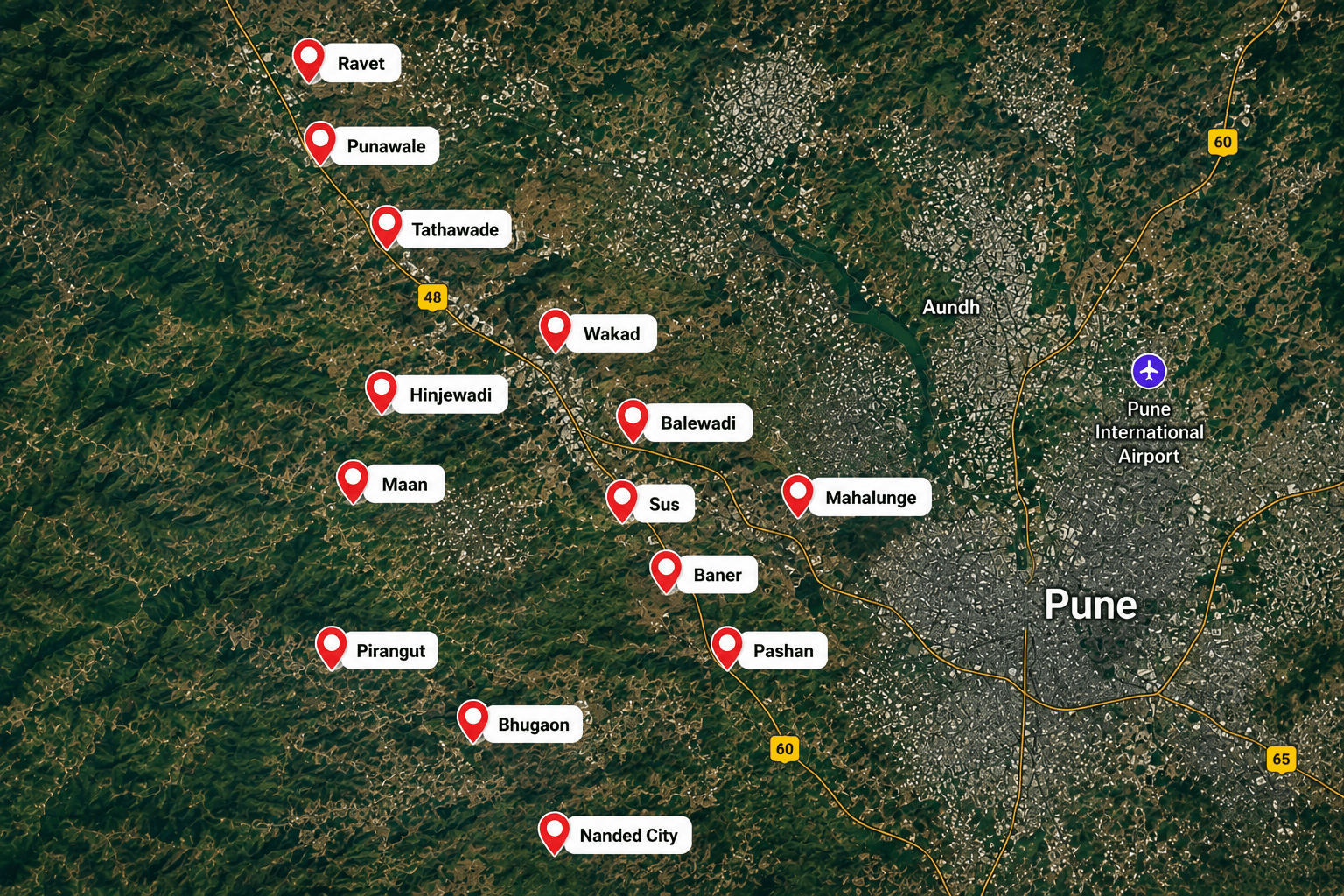
West Pune is often discussed as a single growth story, but it is really a cluster of corridors — Hinjewadi, Wakad, Baner, Balewadi, Punawale, and Tathawade among them — each shaped by a different mix of employment, infrastructure, and buyer profile. Understanding what is actually driving each corridor, rather than treating "West Pune" as one homogeneous market, leads to a much better property decision.
The IT employment corridor sets the pace
Rajiv Gandhi Infotech Park in Hinjewadi remains the single largest employment driver for residential demand across this belt. Its scale has pushed both rental and end-use demand outward into Wakad, Tathawade, and Punawale, where housing supply has grown to accommodate the workforce commuting to Hinjewadi's IT campuses. This employment-led demand is a fundamentally different driver from a purely lifestyle-led corridor, and it shows up in the kind of housing that sells and rents well — compact, well-connected configurations aimed at working professionals and young families rather than large-format luxury housing.
Because so much of the demand in this belt traces back to a single employment cluster, it is also worth understanding what happens if that cluster's growth slows or shifts. Diversification — more employers, more sectors, and stronger standalone social infrastructure — makes a corridor less dependent on any one driver, and is generally a healthier long-term sign than rapid growth tied to a single source.
Infrastructure is catching up with demand
Residential growth in this belt has, for years, outpaced road capacity, which is a fair criticism of the corridor. That said, infrastructure work has been underway to address it — road widening along key stretches, and a metro line connecting Hinjewadi toward the rest of the city has been in various stages of planning and construction. Buyers should treat any specific completion timeline for ongoing infrastructure projects as provisional and verify current status independently rather than relying on sales team assurances, since these projects are subject to the usual execution delays common to large infrastructure works in India.
A practical way to factor this in: value a corridor for what its infrastructure supports today, and treat any planned improvement as a possible upside rather than a reason to pay a premium now. If the project is delayed, your decision should still make sense on today's connectivity alone.
A corridor-by-corridor look
Hinjewadi — employment led
Closest to the IT park itself, Hinjewadi sees strong rental demand from the employee base working across its phases. Housing stock here skews toward compact configurations suited to tenants, with end-user demand growing as social infrastructure matures. Traffic congestion around peak commute hours remains one of the corridor's most commonly cited drawbacks, and is worth experiencing firsthand during a weekday visit rather than judging from a weekend one.
Wakad — mature and well served
Wakad has some of the most established social infrastructure in the belt — schools, hospitals, and retail — along with direct access to the Mumbai–Bangalore highway and link roads toward Aundh. It functions as a more mature residential market than the corridors further west, which is reflected in a wider mix of end-users alongside investors, and generally deeper resale activity than newer, still-developing pockets.
Baner and Balewadi — lifestyle led, higher ticket size
Baner's high street, along with Balewadi's sports and civic infrastructure, has pulled in a more lifestyle-oriented, higher-ticket buyer profile compared to the employment-led corridors further west. Grade-A developer activity has been consistent here, with steady end-user absorption alongside investment interest, and the corridor tends to command a premium over comparable configurations further out.
Punawale and Tathawade — emerging, relatively accessible entry price
These corridors have absorbed much of the spillover demand from Hinjewadi, offering comparatively accessible entry pricing with the trade-off of still-developing social infrastructure and dependence on ongoing road and civic works to fully mature. Buyers considering these pockets should weigh the lower entry price against a realistic timeline for schools, healthcare, and retail to catch up with the pace of residential construction.
Who tends to buy in West Pune, and why it matters
The buyer base across this belt is a mix of IT and adjacent-sector professionals buying their first or second home close to work, families relocating from other parts of Pune for better social infrastructure or larger configurations, and investors targeting rental yield from the employee population. Each of these buyer types weighs the corridors differently — a professional prioritising commute time may accept thinner social infrastructure that a relocating family would not. Being clear about which of these profiles you fall into helps cut through generic corridor comparisons that are not actually written with your priorities in mind, since a ranking built for an investor's rental yield can lead a family toward the wrong corridor entirely.
What this means for buyers
- Weigh the commute-versus-price trade-off honestly against your actual daily routine, not just theoretical distance on a map
- If buying for rental income, match the corridor and configuration to its dominant tenant profile rather than your own preference
- Check the current, verified status of any infrastructure project cited as a reason to buy, rather than an informal timeline
- Compare resale and rental activity within the specific corridor, since depth varies meaningfully even between adjoining ones
A note on caution
A broad growth narrative for West Pune as a region does not automatically apply to every individual project within it. Builder track record, project-specific approvals, and the immediate surroundings of a site still matter as much here as anywhere else — the corridor sets the context, but it does not substitute for evaluating the specific project on its own merits. Treat a strong corridor as a reason to look closer, not a reason to skip the checks you would apply anywhere else.
The bottom line
West Pune's growth is real but uneven, driven by different factors in different pockets. Habitation Oracle's advisory work starts with exactly this kind of corridor-level context before narrowing down to specific projects, because the right micro-market for one buyer's commute and budget is often the wrong one for another's, and a generic recommendation rarely serves either well.